

What is Agroforestry and Why is it so Important?
Agroforestry is the intentional integration of trees and shrubs into agricultural systems. While implementation differs depending on site conditions and the farm’s operation and goals, agroforestry practices can diversify farm income and improve environmental conditions such as water quality, biological diversity, erosion control, soil quality, carbon sequestration, and wildlife habitat.
Many conventional farming practices prioritize short-term yields at the expense of soil health, clean water and air, and wildlife habitat. Agroforestry practices can counter these trends and turn agriculture into a source of ecological health and resilience. It can also increase plant and animal productivity, and provide additional farm revenue streams from bioenergy, timber, and other secondary products. Agroforestry can also buffer land from volatile and unpredictable weather by increasing shade and wind breaks, retaining water runoff, and supporting beneficial insects and soil microbial life.
Successful species selection requires understanding the specific needs and interactions of each crop (e.g., juglone tolerance if using black walnuts) to mitigate competition for light, water, and nutrients. When practical, we strongly recommend prioritizing a diversity of native plants, and thoroughly assessing site conditions, such as water availability, light exposure, airflow, and soil type before beginning a design.
Forest Farming and Multistory Cropping
Diversified perennial systems can produce an abundance of high-calorie crops, often with greater yields, fewer inputs, less ecological disturbance and greater climate benefits than annual cropping systems.
Forest farming describes the production of non-timber forest products either grown in or foraged from woodlands. Planned orchard systems in which crops (other than the orchard crop) or livestock are managed between rows or within the understory, mid-story, or canopy is another example.
Conventional orchards, which are typically monocultures with an herbicide-managed understory, are not considered an agroforestry system because they do not integrate multiple crop layers or diverse species.
Species selection in a planned orchard system may include canopy species that provide timber, nuts, fruit, livestock forage or mast, and broader ecological system support, as well as shade for the other layers. Mid-story species can be selected for coppicing, food for humans and animals, and timber; and understory species which are somewhat to very shade tolerant.


Silvopasture
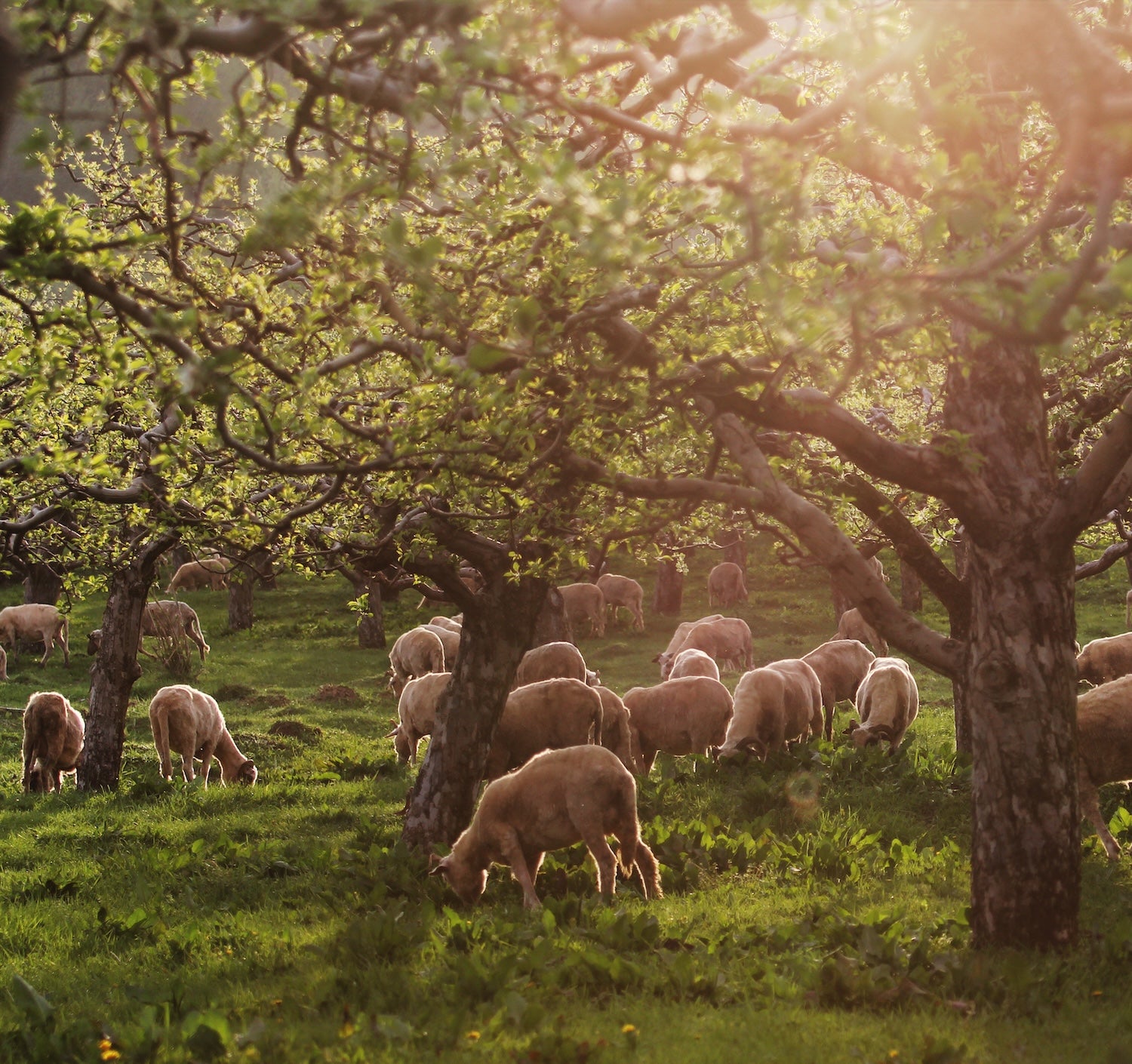
Silvo, meaning forest, and pasture, is a practice that integrates trees, forage and livestock into a single managed system. This can be achieved either by planting trees in and around existing pasture or by introducing livestock to an existing woodland in a controlled manner that supports the health of both the trees and the animals.
In well-designed systems, livestock are rotationally grazed between trees to maintain optimal understory vegetation, reducing the need for mowing. The trees create shade that reduces heat stress and improves pasture growth during periods of extreme heat and drought. This leads to healthier animals that gain weight more easily. Fruits, nuts, and leaves can also provide alternative sources of high quality fodder throughout the season, diversifying livestock diets and increasing resilience in the pasture system. Livestock manure contributes to soil fertility by cycling nutrients back into the system, enriching the rhizosphere and improving long-term soil structure.
When properly designed and implemented, silvopasture systems add biodiversity to farms and enhance animal welfare. Tree species selection and the proper genetics and number of livestock are crucial to a successful silvopasture design. Successful execution requires a deep knowledge of animal husbandry in terms of intensive livestock management, an understanding of grazing and pasture, and horticulture.

Windbreaks & Edible Hedgerows
Windbreaks, hedgerows, shelterbelts, or living fences are linear plantings of woody species designed to modify wind flow and create protective climates. They can provide a wide range of agronomic and ecological benefits with relatively modest space requirements that enhance rather than reduce cropland or pasture.
When designed properly, windbreaks can reduce heating costs of structures and can protect livestock from sun and wind. Windbreaks moderate extreme climate conditions for livestock by offering shade in the summer and reducing wind chill in the winter.
For cropland, windbreaks are particularly valuable on exposed or tilled fields, where disturbed soils are highly erodible by wind. Strategically situated windbreaks slow wind velocity and reduce dust, preserve organic matter, and protect seedbeds and young plants. Moisture loss is also reduced.
Hedges can also serve as critical wildlife corridors, allowing animals to travel between habitat patches in otherwise open fields. When planted with a diverse mix of native trees, shrubs, and herbaceous species, hedgerows supply forage and cover for pollinators, predatory insects, and bird species. Biodiversity of this kind can provide essential pest control and pollination services, helping to keep farm fields in balance with nature and reducing reliance on inputs like pesticides and fertilizers.
Properly designing these windbreaks with a diversity of trees is critical to the proper function of this agroforestry system, regardless of the primary goal. Effective designs often include multiple rows or staggered plantings of different heights and growth habits. Diversity of species leads to reduced susceptibility to pests or diseases, stacking benefits throughout the landscape.

Alley Cropping
Alley cropping integrates widely spaced rows of trees or shrubs with annual crops or perennial hay fields, creating productive “alleys” between the rows of trees. The linear layout enables growers to maintain efficient cropping patterns, while incorporating species that can provide long-term ecological and economic benefits.
Depending on farm goals, species selection may focus on trees grown for timber, fruit, nuts, fodder, or wildlife habitat. Some growers plant shrubs that can fix nitrogen. Between these rows, growers can continue producing annual crops or maintain hayfields and forage.
In some cases, this system is used to transition a farm toward a silvopasture operation, or can allow a farm focusing on annual production the opportunity to slowly transition to new perennial enterprises. The growing area between the tree rows benefits from full sun in the first years after planting. As the canopy closes, growers can transition to different systems in the alleys, such as production of shade-tolerant crops. The area can also be transitioned to a managed grazing system when the trees are large enough to withstand potential browse or rubbing.
Similarly to fields planted next to protective windbreaks, tree rows in this system can create microclimates that are beneficial to the row crops in the alleys. They can mitigate extreme temperatures, reduce windspeeds, enhance moisture retention, and help prevent soil erosion. Deeper roots from perennial trees and shrubs can increase overall fertility and reduce nutrient runoff.
Once the trees have reached productive maturity or have completely shaded out the annual field crops the land has fully transformed into a perennial agriculture system. Over time, alley cropping can increase farm resilience by increasing biodiversity, sequestering carbon, stabilizing soils, and diversifying income streams.
Interested in technical details and tips on implementation? Dig into this publication from the Center for Agroforestry.

Riparian Buffer Zones
Riparian buffer zones are linear plantings or managed strips of perennial vegetation along streams, rivers, or lakes. Although the direct effects may not be obvious, this practice can create major ecological benefits.
Perennial root systems help to anchor the soil along banks, reducing erosion especially during rainstorms. They filter runoff from nearby farm fields, resulting in reduced pollutants like fertilizer and sediment entering the watershed. Resultant downstream contamination is mitigated, thereby reducing algae blooms and maintaining clean water downstream.
Vegetation shades waterways, keeping the water temperature cooler for sensitive aquatic animals. Plants provide habitat corridors for mammals, birds, reptiles, amphibians, and insects. When managed properly with a diversity of native species, riparian buffers can be the most biologically diverse areas of a landscape.
Although these zones are typically designed to prioritize the health of waterways, riparian buffer zones can include harvestable crops. Select species can diversify farmer income and bring flood-prone land into production. Regardless of whether production is a goal in designing riparian buffer zones, these areas are some of the most vulnerable in our landscapes, and their protection and restoration should be a priority for any land steward.


